
Xpeng Iron Humanoid Robot
In stock
- MODEL:
- IRON
- AVAILABILITY:
- SUBJECT TO AVAILABILITY
- SKU:
- Xpeng-Iron
XPENG IRON Humanoid Robot
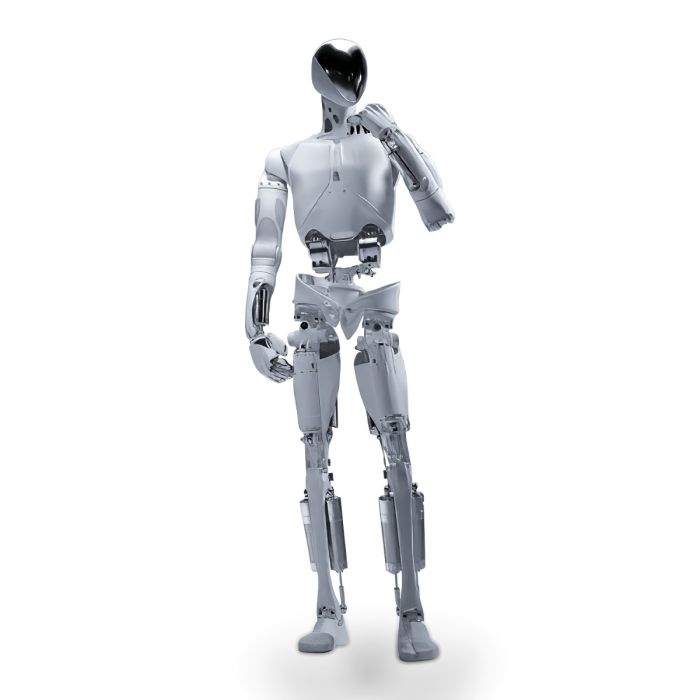
The XPENG IRON Humanoid Robot is a next-generation humanoid AI robot developed by XPENG as the flagship embodiment of the company's Physical AI strategy. Described by its maker as a highly realistic humanoid, IRON is built for dexterous upper-body actions, natural movement through human spaces, and more natural human interaction, with a form intended to adapt to the environments people already occupy. In a 2026 press release, XPENG announced that a humanoid robot production line had been commissioned and that IRON autonomously walked off that line, presented as evidence the platform has moved beyond one-off prototypes. XPENG positions IRON as a general-purpose humanoid platform designed for safety, pairing a fully enclosed flexible lattice structure with substantial onboard computing. As with any emerging humanoid system, many published capabilities have been shown in laboratory or demonstration settings, and that context matters when evaluating the platform.
Background
XPENG is best known as an electric vehicle maker, and that heritage shapes how it presents IRON: as a manufactured product backed by industrial process discipline rather than a research curiosity.
From Automotive Engineering to Physical AI
In its 2026 press release, XPENG announced the commissioning of a humanoid robot production line with core process automation exceeding 80 percent and manufacturing carried out to automotive-grade standards. The company marked the occasion with a pointed image: IRON walking off the production line autonomously, under its own control. XPENG presents the robot as a pillar of its Physical AI strategy, the idea that artificial intelligence should act in the physical world through capable machines rather than remain confined to screens. A commissioned line signals that XPENG intends to build IRON at meaningful volume rather than assembling demonstrators by hand, which is a different posture from programs that exist only as staged prototypes.
A Realistic Form Designed Around People
IRON is described by XPENG as a highly realistic humanoid, engineered for dexterous upper-body actions and natural movement through spaces designed for people. Its body is built around a fully enclosed flexible lattice structure, a design choice XPENG links to the platform's safety-oriented, general-purpose positioning. The company also emphasizes form adaptation, meaning the robot is intended to fit the environments and interaction patterns humans already use and to support more natural human interaction as a result. XPENG itself acknowledges that many capabilities have been demonstrated in laboratory settings, so performance in a specific facility should be validated during evaluation.
Technical Specifications
The table below consolidates the figures and design statements XPENG has published for IRON.
| Attribute | Detail as published by XPENG |
|---|---|
| Platform type | General-purpose humanoid AI robot |
| Degrees of freedom | 76 across the body |
| Hand articulation | 21 degrees of freedom in each hand |
| Onboard computing | Three Turing AI chips, up to 2,250 TOPS |
| AI architecture | On-robot physical AI foundation model |
| Autonomy | Complex tasks without remote operation |
| Data handling | Low latency with an emphasis on data security |
| Structure | Fully enclosed flexible lattice structure |
| Manufacturing | Automotive-grade line, core process automation above 80 percent |
| Initial scenarios | XPENG stores and campuses, as announced |
| Launch and delivery | Planned for 2027, as announced |
These specifications reflect manufacturer statements and announcements at the time of writing; production configurations can change, and final details should be confirmed during quotation.
How does the XPENG IRON handle perception and decision-making?
IRON carries three Turing AI chips delivering up to 2,250 TOPS of computing performance. That capacity exists to run an on-robot physical AI foundation model, meaning the intelligence that drives the robot operates on the machine itself rather than in a remote data center. XPENG cites two practical benefits: low latency, since decisions happen where the sensors and actuators are, and data security, since information about the robot's surroundings need not leave the device to be processed. On this foundation, XPENG says IRON can complete complex tasks autonomously without remote operation, though buyers should remember that many demonstrations to date have taken place in controlled settings.
Why does automotive-grade manufacturing matter for a humanoid robot?
Most humanoid robots shown publicly are effectively hand-built prototypes, which makes consistency between units difficult to guarantee. XPENG's approach borrows from its automotive business: a commissioned production line, automation of more than 80 percent of core processes, and quality standards drawn from vehicle manufacturing. Repeatable manufacturing is what turns a compelling demonstration into a product that behaves predictably from unit to unit. The image of IRON autonomously walking off its own production line was chosen to make exactly that point. It remains an announced capability ramp rather than a delivery record, but it distinguishes IRON's roadmap from lab-only programs.
Who is the XPENG IRON Humanoid Robot for?
IRON is intended for organizations that want structured, early exposure to general-purpose humanoids rather than a turnkey replacement for human labor. Research institutions and university robotics programs gain a production-built humanoid with unusually dexterous 21-DOF hands to study. Corporate innovation and R&D teams evaluating embodied AI get a platform whose on-robot foundation model can be exercised against real tasks. Operators of retail spaces, showrooms, and corporate campuses map directly onto XPENG's announced initial commercial scenarios, and systems integrators can assess the platform for future customer-facing deployments. Ahead of the announced 2027 launch, all of these audiences should treat engagement as evaluation and planning rather than large-scale rollout.
What is the XPENG IRON Humanoid Robot used for?
XPENG's published material points to a defined set of early applications.
- Retail and showroom engagement. XPENG's announced first commercial scenario places IRON in its own stores, supporting customer-facing activity in busy public environments.
- Corporate campus services. Campuses form the second announced deployment setting, where the robot can perform routine support tasks among employees.
- Human-robot interaction research. The realistic form, natural movement, and interaction focus make IRON a strong subject for studying how people respond to lifelike humanoids.
- Embodied AI development. The on-robot physical AI foundation model and up to 2,250 TOPS of compute give AI teams a vehicle for developing and testing autonomous behaviors.
- Technology demonstrations. Organizations can build exhibitions and innovation showcases around a humanoid backed by an automotive-grade production line.
- Workflow evaluation. Early adopters can trial general-purpose humanoid tasks in controlled pilots before committing to wider deployment plans.
Pricing and Availability
XPENG has not published a list price for IRON, and pricing for advanced humanoid platforms typically depends on configuration, support, and deployment scope. Configuration and final pricing should be confirmed during quotation. Purchase details are available on this page. On availability, XPENG has announced that launch and delivery are planned for 2027, with initial commercial scenarios in its own stores and campuses; this is an announced timeline rather than a guaranteed schedule, and prospective buyers should plan evaluations accordingly.
Frequently Asked Questions
What is the XPENG IRON Humanoid Robot?
IRON is a next-generation general-purpose humanoid AI robot from XPENG, built for dexterous upper-body work, natural movement in human spaces, and natural interaction with people, and positioned as the flagship of the company's Physical AI strategy.
How many degrees of freedom does the XPENG IRON have?
XPENG states that IRON has 76 degrees of freedom across its body, with each hand providing a further 21 degrees of freedom for fine manipulation tasks.
What computing hardware does the XPENG IRON use?
The robot carries three Turing AI chips delivering up to 2,250 TOPS, which run an on-robot physical AI foundation model with low latency and an emphasis on data security.
Can the XPENG IRON operate without remote control?
According to XPENG, IRON is designed to complete complex tasks autonomously without remote operation, although many demonstrations to date have taken place in laboratory settings.
When will the XPENG IRON be available?
XPENG has announced that launch and delivery are planned for 2027. This is an announced timeline rather than a guarantee and may change as the program develops.
Where will the XPENG IRON be deployed first?
XPENG has said the initial commercial scenarios will be its own stores and campuses, where the robot can be exercised in controlled, customer-facing environments.
Where can I buy XPENG IRON Humanoid Robot and what does it cost?
XPENG has not published a price for IRON. Purchase details are available on this page, and configuration and final pricing should be confirmed during quotation.
Summary
The XPENG IRON Humanoid Robot pairs an ambitious general-purpose design with a concrete manufacturing story: 76 degrees of freedom, dexterous 21-DOF hands, and up to 2,250 TOPS of onboard compute running a physical AI foundation model, produced on a commissioned automotive-grade line that the robot walked off autonomously. The announced 2027 launch and the initial store and campus deployments will show how the platform performs outside demonstrations. For organizations comparing advanced humanoid platforms, this page is the starting point.