BrainCo Revo 3-21 Touch Robot Hand
In stock
- BRAND:
- BRAINCO
- MODEL:
- REVO 3-21 TOUCH
- ORIGIN:
- China
- Warranty:
- 12 MONTHS
- AVAILABILITY:
- SUBJECT TO AVAILABILITY
- SKU:
- BrainCo-Revo-3-Touch
BrainCo Revo 3-21 Touch Robot Hand
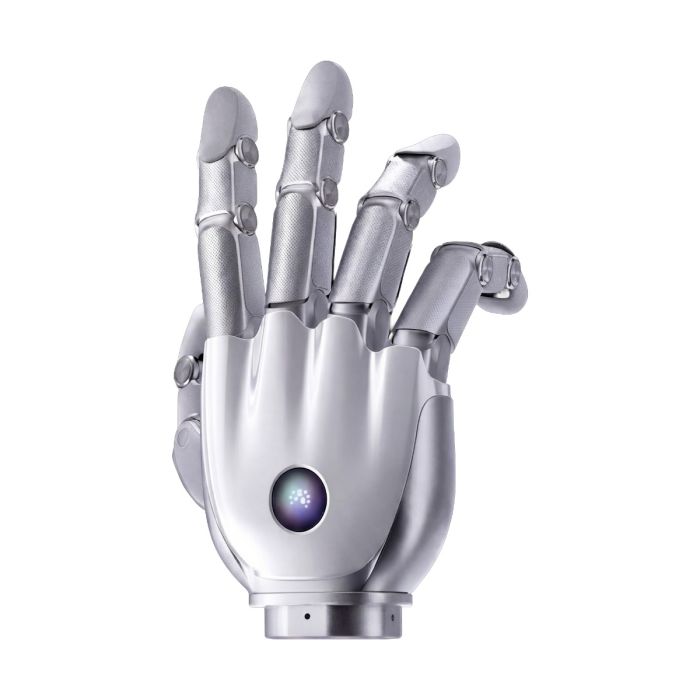
Dexterity is often judged by how a hand moves; the harder test is whether it knows what it is holding. The BrainCo Revo 3-21 Touch Robot Hand is built for that test. It joins 21 independently driven motors to a piezoresistive tactile array across the palm, so that a controller receives a record of contact as well as a record of motion. For research groups and integrators who treat the hand as the limiting component of a manipulation system, that pairing is the reason to look closely.
The BrainCo Revo 3-21 Touch Robot Hand is available through this page, by quotation.
Background
BrainCo and the Revo lineage
BrainCo is a Hangzhou-based brain-computer interface company. Its Revo family of dexterous hands has been developed over several generations, and earlier models such as the Brainco Revo 2 Touch Biomimetic Dexterous Right Hand (XTR) and the BrainCo Revo 1 Intelligent Dexterous Bionic Hand remain part of the wider range. The Revo 3 is the third generation, and it is presented as a platform with four versions: Revo 3 U21, Revo 3 U21F, Revo 3 U21T and Revo 3 U21VT. The manufacturer describes the hand as designed for industrial automation, scientific research and advanced robotics manipulation.
The versions share the same mechanical core. What separates them is the tactile equipment: one version carries no tactile array, one carries fingertip tactile sensing, and two carry full-palm tactile sensing. The model described on this page, the Revo 3 U21T, belongs to the full-palm group. All Revo 3 products are gathered in the BrainCo Revo 3 category.
Direct drive, backdrivability and a tactile palm
The hand has 21 independently driven motors and 21 fully active degrees of freedom, all direct-driven and backdrivable. Direct drive removes the tendon or linkage layers found in many hands, and backdrivability means that the fingers yield when an external force pushes on them. For a robot that works near people, or that must be taught by guiding the hand through a motion, that compliance is a practical advantage rather than a convenience.
On the Revo 3 U21T the sensing layer is a full-palm piezoresistive array of 451 points. The mainboard also carries an inertial measurement unit and a temperature sensor. The form factor is compact and lightweight in the manufacturer's own description, which matters when the hand is mounted at the end of a humanoid arm with a limited wrist payload.
Technical Specifications
| Specification | Value |
|---|---|
| Model | Revo 3 U21T |
| Total degrees of freedom | 21 (direct-driven and backdrivable) |
| Motors | 21 independent motors |
| Hand dimensions | 216 × 108 × 50 mm |
| Supply voltage | 16–85 V |
| Max current | 10 A (24 V) |
| Max active grip force | ≥100 N |
| Max fingertip pinch force | ≥25 N |
| Total hand payload | 20 kg |
| Four-finger payload | 5 kg |
| Repeatability | 0.1° |
| Joint open/close time | 0.33 s |
| Grasp coverage | 33 grasp types (Feix GRASP taxonomy); full score on the Kapandji opposition test |
| Communication interfaces | EtherCAT / CAN FD / RS-485 |
| Communication frequency | 500 Hz |
| Onboard sensors | IMU (mainboard), temperature (mainboard) |
| Tactile distribution | Full-palm tactile |
| Tactile type | Full-palm piezoresistive array |
| Tactile array | 451 points (piezoresistive) |
| Durability | Rated for over 1,000,000 joint flex cycles |
| Software | C/C++ and Python SDKs for Linux and Windows; ROS support |
| Recommended power supply | Stable 24V DC, rated at least 100W |
Specifications as published by the manufacturer; confirmed against the datasheet at quotation. The manufacturer has not published the weight, the IP rating, the box contents, the operating temperature range or the hand material; they are confirmed at quotation.
What makes the Revo 3-21 Touch different from the other Revo 3 versions?
The mechanical and electrical figures are the same across the four Revo 3 versions: the same 21 degrees of freedom, the same dimensions, the same supply range, the same communication interfaces. The difference lies in where the hand can feel. The U21 version has no tactile distribution listed, the U21F has fingertip tactile sensing, and the U21T described here has full-palm tactile sensing, as does the U21VT.
That distinction decides what a controller can learn. Fingertip sensing reports contact at the points where a pinch is made. A palm array of 451 points also reports where a held object rests against the base of the hand, how a handle is seated in the grip, and whether a load is shifting. For a plain pick-and-place task that extra information may be unnecessary; for work in which the palm takes part in the grasp, it is the central feature. Buyers who do not need tactile data may prefer to compare the BrainCo Revo 3-21 Basic Robot Hand.
How does the Revo 3-21 Touch compare with earlier Revo hands?
The Revo 3 raises the number of independently driven degrees of freedom to 21 and pairs them with direct-driven, backdrivable joints. Its communication options include EtherCAT and CAN FD in addition to RS-485, and the interface runs at 500 Hz, which suits real-time control loops. The manufacturer states coverage of 33 grasp types from the Feix GRASP taxonomy and a full score on the Kapandji opposition test, both of which describe how completely the thumb and fingers can reproduce human grasping.
Durability is stated as over 1,000,000 joint flex cycles. Readers who need a lower-specification or earlier hand can look at the Revo 2 range, for example the BrainCo Revo 2 Basic Right Dexterous Bionic Hand (XRR); the Revo 3 U21T is the choice when full-palm tactile sensing and the wider interface set are the requirement.
Who is the BrainCo Revo 3-21 Touch Robot Hand for?
Research laboratories are the clearest segment. A hand that records palm contact and exposes 21 independently driven joints gives teams working on learning-based manipulation, teleoperation or tactile perception a platform that produces useful data from the first session. The C/C++ and Python SDKs, the Linux and Windows support and the ROS support fit the toolchains such groups already use.
Humanoid developers form the second segment. The compact 216 × 108 × 50 mm body and direct-driven joints suit an end-effector that must be mounted on an arm and then trained to handle varied objects. Industrial automation teams form the third, particularly where parts are irregular and a fixed gripper would need frequent changeovers; the EtherCAT interface connects to common industrial controllers.
Buyers who need the same articulation without palm sensing should consider the Basic version, and those who want to compare another tactile variant can review the BrainCo Revo 3-21 V-Touch Robot Hand.
What is the BrainCo Revo 3-21 Touch Robot Hand used for?
- Tactile manipulation research: the 451-point palm array supplies contact data for studies of grasp stability and slip.
- Humanoid robot end-effectors: a 21-degree-of-freedom hand gives a humanoid platform the means to handle tools and varied objects.
- Teleoperation and demonstration learning: backdrivable joints and a 500 Hz interface support guided motions and operator-driven control.
- Flexible industrial handling: coverage of 33 grasp types suits mixed parts that a fixed gripper cannot hold.
- Assembly and tool use: independently driven fingers, with a 0.1° repeatability, allow repeated precise positioning of a held item.
- Teaching and prototyping: the Python and C/C++ SDKs let students and engineers build and test grasp strategies quickly.
Pricing and Availability
No price is printed on this page. A quotation is the way to obtain terms for the BrainCo Revo 3-21 Touch Robot Hand, and it is also where the specification is confirmed against the datasheet. Delivery, customs and support are arranged with the quotation. The Revo 3-21 Touch Robot Hand is available on this page.
Frequently Asked Questions
How many degrees of freedom does the Revo 3-21 Touch have?
It has 21 degrees of freedom, each driven by its own motor. The joints are direct-driven and backdrivable.
What tactile sensing does this version carry?
The Revo 3 U21T has full-palm tactile sensing based on a piezoresistive array of 451 points. The mainboard also holds an IMU and a temperature sensor.
Which communication interfaces are available?
The hand supports EtherCAT, CAN FD and RS-485, with a communication frequency of 500 Hz.
What power supply is recommended?
The manufacturer recommends a stable 24V DC supply rated at least 100W, to reduce the risk of voltage drop. The supply voltage range is 16–85 V and the maximum current is 10 A at 24 V.
Which software is supported?
C/C++ and Python SDKs are provided for Linux and Windows, and ROS is supported.
How much can the hand lift?
The total hand payload is 20 kg, and the four-finger payload is 5 kg. The maximum active grip force is at least 100 N and the fingertip pinch force is at least 25 N.
Where can I buy the BrainCo Revo 3-21 Touch Robot Hand and what does it cost?
It is available through this page, by quotation. No price is shown here; request a quotation and the terms will be confirmed with it.
Summary
A hand that only moves is half a tool; one that also feels can learn from what it holds. The BrainCo Revo 3-21 Touch Robot Hand combines 21 independently driven, backdrivable degrees of freedom with full-palm tactile sensing, EtherCAT and CAN FD communication, and SDK support for common research and industrial toolchains. It suits laboratories, humanoid developers and automation teams for whom contact information matters. To discuss a specification or request terms, this page is the starting point.