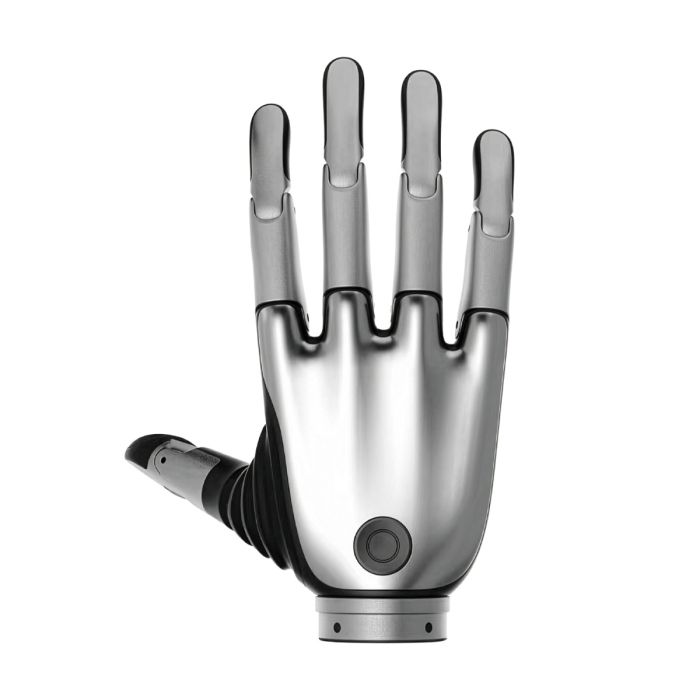
Brainco Revo 2 Touch Biomimetic Dexterous Right Hand (XTR)
In stock
- BRAND:
- BRAINCO
- MODEL:
- REVO 2 TOUCH
- PART #:
- XTR
- ORIGIN:
- China
- AVAILABILITY:
- SUBJECT TO AVAILABILITY
- SKU:
- BrainCo-Revo-2-Touch
Brainco Revo 2 Touch Biomimetic Dexterous Right Hand (XTR)
Closing fingers around an object is the easy half of grasping; knowing what happened once they have closed is the hard half. The Brainco Revo 2 Touch Biomimetic Dexterous Right Hand (XTR) is the version of the Revo 2 family built around that second half, a bionic hand for robot integration and research that carries a multi-dimensional fingertip tactile module at the point of contact.
The product is available through this page, by quotation.
Background
BrainCo and its lineage
BrainCo was founded in 2015 and incubated by the Harvard Innovation Lab (i-Lab); the company is based in Somerville, Massachusetts. Its work has centred on the meeting point between people and machines, and its dexterous hands carry that thinking into robotics. The Revo name has been used across more than one generation: the BrainCo Revo 1 Intelligent Dexterous Bionic Hand preceded the present Revo 2 family.
For a buyer, this lineage matters chiefly because it points to a maker that has returned to the category and refined it, rather than one that has released a single product and moved on.
Where the Touch version sits in the Revo 2 family
The Revo 2 family is offered in three versions, each with a left and a right hand. The Basic version carries the codes XRL and XRR, the Pro version XEL and XER, and the Touch version XTL and XTR. The product described here is the right hand of the Touch version, code XTR; its left-hand counterpart is the Brainco Revo 2 Touch Biomimetic Dexterous Left Hand (XTL).
What distinguishes the Touch version is its multi-dimensional fingertip tactile module. Where a hand without such a module must infer contact from motor current or from a camera, this version is designed to report contact at the fingertip itself. That makes it a natural fit for laboratories and integrators who are studying how a robot should hold, adjust and release an object, and not merely whether it can lift one.
Technical Specifications
| Specification | Value |
|---|---|
| Product type | Bionic dexterous hand for robot integration and research |
| Version code | XTR (Touch, right hand) |
| Pinch force | ≥15N |
| Control precision | 0.1° |
| Tactile module | Multi-dimensional fingertip tactile module |
| Communication interfaces | RS-485, CAN FD, EtherCAT |
| Interface location | Below the wrist |
| SDK | Python and C; compatible with Linux, Windows and ROS |
| Protections | Current, stall, high-temperature and anti-collision protection |
| Default device ID (right hand) | 127 |
| Standard colours | Space Gray, Silver (bulk colour customisation supported) |
Specifications as published by the manufacturer; confirmed against the datasheet at quotation.
The manufacturer has not published the package contents, the ingress protection rating, the tactile sensor resolution or the cable length; they are confirmed at quotation.
What makes the Revo 2 Touch different from the Basic and Pro versions?
The three versions share the Revo 2 platform, and the difference lies in what each adds to it. The Touch version is the one that carries the multi-dimensional fingertip tactile module. For work in which the quality of contact is itself the subject of the experiment, that module is the reason to choose it.
The communication options are also worth noting. The advanced and tactile versions support three interfaces, RS-485, CAN FD and EtherCAT, for communication and control, with the connection located below the wrist. A team that intends to place the hand on an industrial or real-time fieldbus will therefore find the Touch version equipped for it.
Teams that do not need tactile feedback may prefer a sibling. The BrainCo Revo 2 Pro Dexterous Right Hand (XER) and the BrainCo Revo 2 Basic Right Dexterous Bionic Hand (XRR) are listed for that purpose, and their figures should be taken from their own pages and not read across from this one.
Which interfaces and software does the Revo 2 Touch support?
On the hardware side, the hand offers RS-485, CAN FD and EtherCAT. In practice this allows a simple serial link on a bench, a CAN FD network in a mobile platform, or EtherCAT in a synchronised multi-axis installation, all through the one connection below the wrist.
On the software side, the SDK supports Python and C and is compatible with Linux, Windows and ROS systems. A laboratory working in ROS can bring the hand into an existing graph, while a team that prefers to write directly against the hand can use C. Where several hands share one bus, the default device ID for the right hand is 127, and the left hand uses 126; this is worth recording at the outset so that a pair of hands can be addressed without conflict.
The hand also has protective functions built in: current protection, stall protection, high-temperature protection and anti-collision protection. For a research environment in which commands are frequently changed and mistakes are expected, such protections reduce the risk to the hand and to the objects it handles.
Who is the Revo 2 Touch for?
The principal buyer is the research laboratory studying manipulation: groups working on grasp stability, slip detection, in-hand adjustment or learning from contact. For them, a fingertip tactile module is a source of data that vision cannot supply.
The second buyer is the humanoid developer. A humanoid platform needs a hand that can be integrated with its arm and its controller, and the choice of three interfaces and a ROS-compatible SDK eases that task.
The third is the systems integrator building a research or pilot cell, who values predictable control precision and the stated protections. Those who do not need tactile sensing may find that the Pro or Basic version meets the requirement. Further options appear under Hands and in the Research Robots category.
What is the Revo 2 Touch used for?
- Tactile manipulation research. Studying how contact at the fingertip shapes grasp planning and adjustment.
- Humanoid robot hands. Giving a humanoid platform a right hand with human-like grasping.
- Robot arm end-effector work. Replacing a simple gripper where the task calls for dexterity.
- Controller and fieldbus development. Testing control over RS-485, CAN FD or EtherCAT.
- ROS-based experiments. Building and comparing behaviours through the Python and C SDK on Linux or Windows.
- Teaching and demonstration. Showing students and visitors what a bionic hand with tactile feedback can do.
Pricing and Availability
No price is printed on this page. A quotation is the way to proceed: it fixes the version, the configuration and the colour. Delivery, customs and support are arranged together with the quotation. The Brainco Revo 2 Touch Biomimetic Dexterous Right Hand (XTR) is available on this page.
Frequently Asked Questions
Is the XTR a right hand or a left hand?
The XTR is the right hand of the Touch version. The left-hand counterpart carries the code XTL.
What does the Touch version add?
It carries a multi-dimensional fingertip tactile module, which allows contact to be sensed at the fingertip.
Which communication interfaces does it offer?
It supports RS-485, CAN FD and EtherCAT, with the interface located below the wrist.
Which software environments are supported?
The SDK supports Python and C, and is compatible with Linux, Windows and ROS systems.
What protections does the hand include?
It includes current, stall, high-temperature and anti-collision protection.
What is the default device ID of the right hand?
The default ID of the right hand is 127, while the left hand uses 126.
Where can I buy the Revo 2 Touch (XTR) and what does it cost?
It is available through this page, by quotation. No price is shown; request a quotation and the terms will be given in writing.
Summary
A hand that grasps without feeling leaves the controller guessing at the decisive moment. The Brainco Revo 2 Touch Biomimetic Dexterous Right Hand (XTR) addresses this with a fingertip tactile module, a control precision of 0.1°, a pinch force of ≥15N, three communication interfaces and an SDK that fits Linux, Windows and ROS. It suits laboratories, humanoid developers and integrators who treat contact as data. For a quotation on this hand, this page is the starting point.
Specifications
General
Physical
Mobility
Performance
Connectivity
Software
Hand
Shipping
What's included
Videos