
BrainCo Revo 2 Basic Right Dexterous Bionic Hand (XRR)
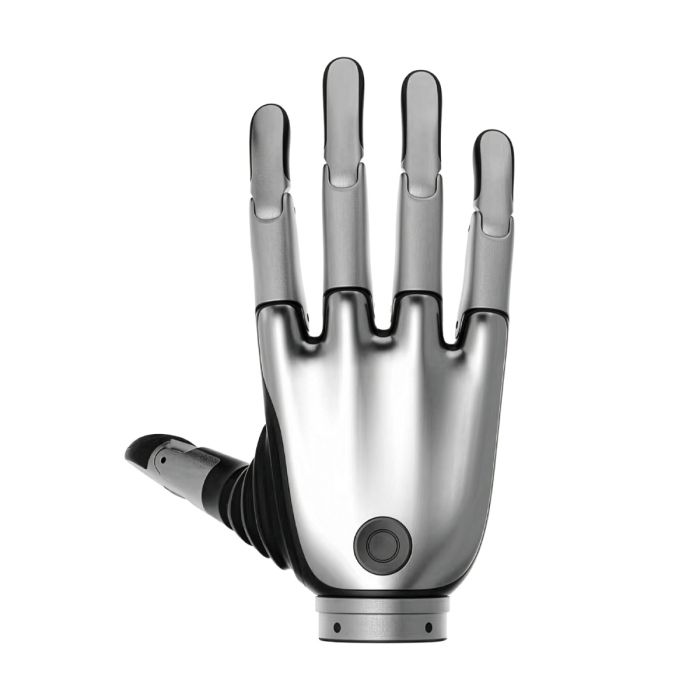
In stock
- BRAND:
- BRAINCO
- MODEL:
- REVO 2 BASIC
- PART #:
- XRL/XRR
- ORIGIN:
- China
- Warranty:
- 12 MONTHS
- AVAILABILITY:
- SUBJECT TO AVAILABILITY
- SKU:
- BrainCo-Revo-2-Basic
BrainCo Revo 2 Basic Right Dexterous Bionic Hand (XRR)
Humanoid robots are rarely built one hand at a time, yet their hands are almost always specified that way. Each side of a two-handed platform is a separate component with its own place on the communication bus, and ordering the correct side matters as much as ordering the correct model. The BrainCo Revo 2 Basic Right Dexterous Bionic Hand (XRR) is the right-hand member of the Basic configuration, a bionic dexterous hand that its published source describes as intended for robot integration and research. Its mirror image is catalogued separately, and the two are distinguished not only by their shape but by a documented default device identifier, which spares an integrator a good deal of guesswork when both are fitted to the same machine.
The hand is available through this page, by quotation.
Background
BrainCo and the Revo name
BrainCo is generally associated with neurotechnology and bionic hand development, and the Revo name carries that bionic emphasis into robotics. The Revo 2 family is offered in three named versions, Basic, Pro and Touch, each produced in left- and right-hand form and each identified by its own version code. BrainCo also lists the BrainCo Revo 1 Intelligent Dexterous Bionic Hand as a separate product. For buyers comparing the range as a whole, the BrainCo Revo 2 category gathers every version in one place.
Where the Basic configuration sits
Within the family, the Basic version carries the version codes XRL and XRR, the final letter marking the left or the right hand; this product is the XRR. Per the published specification, the Pro version is coded XEL/XER and the Touch version XTL/XTR. The sources available to us describe the Basic configuration's communication connector and its default device identifiers, but they do not set out in detail how the three versions differ in capability. That comparison is therefore best settled with the manufacturer's datasheet at quotation, rather than inferred from the version names alone.
Technical Specifications
| Specification | Value |
|---|---|
| Product type | Bionic dexterous hand for robot integration and research |
| Hand side | Right |
| Version code | XRR (Basic family: XRL/XRR) |
| Degrees of freedom | 11 (6 active) |
| Communication interface connector | BM05B-PASS-TFT(LF)(SN) |
| Connector location | Under the wrist |
| Default device ID | 127 (right hand); 126 for the left hand |
| IP rating | Not published; confirmed at quotation |
| Dimensions with wrist | Not published; confirmed at quotation |
| Flexion/extension lifespan | Not published; confirmed at quotation |
| Battery | Not published; confirmed at quotation |
All figures above are reported by a single published source and are to be confirmed against the manufacturer's datasheet at quotation.
What do 11 degrees of freedom with 6 active mean on a robot hand?
The published specification gives the Revo 2 Basic 11 degrees of freedom, of which 6 are active. In dexterous hands generally, an active degree of freedom is one driven directly by an actuator, while the remaining joints move in coordination with them through the hand's mechanism rather than under independent control. The practical consequence is a hand whose fingers can curl and conform in a natural-looking way while the control software commands a smaller, more manageable set of inputs.
For a research team, that balance has a clear appeal. Fewer controlled axes simplify the control problem, shorten calibration and make grasp behaviour easier to reproduce between trials, while the additional passive joints let the fingers wrap around objects of differing shapes. Whether that suits a given project depends on how much individual joint control the work actually demands. A study of in-hand manipulation at the level of single joints will ask different questions of a hand than a programme focused on reliable grasping for a humanoid. The exact allocation of active and coupled joints is not detailed in our source, and it is worth confirming against the datasheet at quotation.
How does the Revo 2 Basic differ from the Pro and Touch versions?
What the sources establish is that the three versions share the Revo 2 name, appear side by side in the same published specification table and carry distinct version codes. For the Basic version specifically, the source documents a communication connector of type BM05B-PASS-TFT(LF)(SN), mounted under the wrist, and the default device identifiers of 126 for the left hand and 127 for the right.
What the sources do not establish, in the material available to us, is a feature-by-feature account of what the Pro and Touch versions add. The names invite assumptions, but assumptions are a poor basis for an engineering decision, and we would rather state the gap plainly than fill it. Buyers weighing the versions against one another should request the datasheets for each at quotation, so that the comparison rests on the manufacturer's own figures rather than on our reading of a product name.
Who is the BrainCo Revo 2 Basic Right Dexterous Bionic Hand (XRR) for?
The first audience is the robot integrator fitting a hand to a right-side arm or to the right side of a humanoid platform. The documented connector and default identifier give such a team the information it needs to plan cabling and bus addressing before the hand arrives, which is precisely the stage at which delays tend to accumulate.
The second audience is the research laboratory. Universities and corporate research groups studying grasping, manipulation or human-robot interaction need a hand that is described and documented for that purpose, and the source positions the Revo 2 for exactly this kind of work.
Teams building two-handed systems will want the mirror unit as well: the BrainCo Revo 2 Basic Left Dexterous Bionic Hand (XRL) pairs with this hand, and their different default identifiers allow both to be addressed without manual reconfiguration on a shared bus. Projects whose requirements go beyond the Basic configuration should consider the BrainCo Revo 2 Pro Dexterous Right Hand (XER) or the Brainco Revo 2 Touch Biomimetic Dexterous Right Hand (XTR), and compare the datasheets of all three before committing.
What is the BrainCo Revo 2 Basic Right Dexterous Bionic Hand (XRR) used for?
- Humanoid robot builds — serving as the right hand of a humanoid platform designed to work in human-shaped environments.
- Grasping research — studying how a multi-jointed hand conforms to and holds objects of differing geometry.
- Two-handed manipulation — working alongside the left-hand XRL in experiments that require coordination between both hands.
- Robot arm end effectors — replacing a conventional gripper where a task benefits from a human-like grasp.
- Learning and teleoperation studies — providing a physical hand for collecting demonstration data and testing learned control policies.
- Teaching and demonstration — illustrating bionic hand design and dexterous control in university courses and laboratory showcases.
Pricing and Availability
The hand is supplied by quotation, which allows the configuration, the hand side and any accompanying units to be confirmed against the project before an order is placed. Delivery, customs and support are arranged together with the quotation. To begin, submit a request for the BrainCo Revo 2 Basic Right Dexterous Bionic Hand (XRR), available on this page.
Frequently Asked Questions
Is this a left or a right hand?
It is the right hand, version code XRR. The corresponding left hand in the Basic configuration carries the code XRL.
What is the default device ID of the right hand?
Per the published source, the right hand's default ID is 127 and the left hand's is 126. This should be confirmed against the datasheet at quotation.
Where is the communication connector?
The source reports that the interface is located under the wrist and that the connector model is BM05B-PASS-TFT(LF)(SN).
How many degrees of freedom does the hand have?
The published specification lists 11 degrees of freedom, 6 of them active. The figure comes from a single source and is to be confirmed at quotation.
What is the hand's IP rating?
The manufacturer has not published an IP rating for this hand. It is confirmed at quotation.
Does the hand have a battery, and what are its dimensions with the wrist?
Neither the battery nor the dimensions with the wrist have been published, and the flexion/extension lifespan is likewise unpublished. All three are confirmed at quotation.
Where can I buy the BrainCo Revo 2 Basic Right Dexterous Bionic Hand (XRR) and what does it cost?
It can be ordered through this page by requesting a quotation. The cost is set out in that quotation, together with delivery, customs and support arrangements.
Summary
A two-handed robot is assembled one side at a time, and the right hand has to be the right hand in every sense: correctly shaped, correctly coded and correctly addressed on the bus. The BrainCo Revo 2 Basic Right Dexterous Bionic Hand (XRR) meets that requirement with a published version code, a documented connector beneath the wrist and a default identifier distinct from its left-hand partner, while its reported 11 degrees of freedom, 6 of them active, give researchers and integrators a human-like hand to work with. Where the sources are silent, on the IP rating, the dimensions with the wrist, the lifespan and the battery, the quotation fills the gap with the manufacturer's own figures. For teams ready to specify either side of their next platform, this page is the starting point.