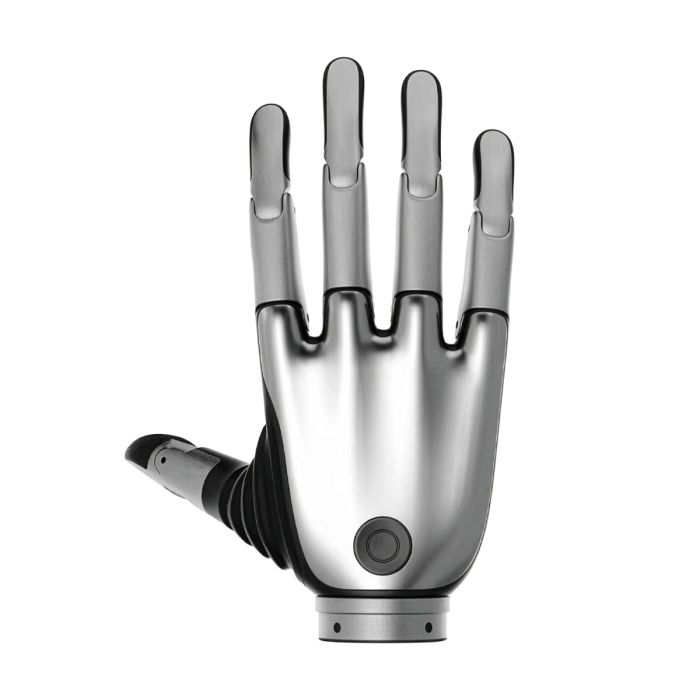
BrainCo Revo 2 Basic Left Dexterous Bionic Hand (XRL)
In stock
- BRAND:
- BRAINCO
- MODEL:
- REVO 2 BASIC
- PART #:
- XRL
- ORIGIN:
- China
- Warranty:
- 12 MONTHS
- AVAILABILITY:
- SUBJECT TO AVAILABILITY
- SKU:
- BrainCo-Revo-2-Basic-Left
BrainCo Revo 2 Basic Left Dexterous Bionic Hand (XRL)
Robotics procurement has a habit of reaching for the top of the range, as though every project needed every feature. A more disciplined question is what a hand must carry to do the work well and nothing more, because each surplus capability costs power, wiring and integration time. The BrainCo Revo 2 Basic Left Dexterous Bionic Hand (XRL) is the answer to that question within the Revo 2 family: the left-hand Basic version, with the leanest published electrical draw of the three versions, a familiar pair of communication buses and the same bionic five-finger architecture that the family shares. It is described by its maker as a bionic dexterous hand for robot integration and research, and it is pitched squarely at teams who want a capable left hand rather than an elaborate one.
The hand is available through this page by quotation. Specify the configuration your project requires, and a formal quotation will follow.
Background
BrainCo and the Revo line
BrainCo is a technology company whose robotic hands sit alongside wider work on human-machine interfaces. The Revo 2 is the second generation of its dexterous hand, succeeding the BrainCo Revo 1 Intelligent Dexterous Bionic Hand. The intention of a second generation is to take a working concept and refine it for integration: an SDK in common languages, support for over-the-air firmware updates, and protections that allow the hand to be left running on a test bench or a robot without constant supervision. The Revo 2 family is published in three versions, Basic, Pro and Touch, each available in left and right forms, and the full range can be seen in the BrainCo Revo 2 category.
Where the Basic sits in the Revo 2 family
The version codes make the structure clear. The Basic is published as XRL and XRR, the Pro as XEL and XER, and the Touch as XTL and XTR, with the final letter indicating the left or right hand. This page concerns the XRL, the left-hand Basic. According to the published specification, the Basic runs from a narrower supply range than its siblings and draws less current when idle, while the repetitive control precision of 0.1° is listed identically for all three versions. In practical terms, the Basic offers the family's mechanical hand and control behaviour on a more modest electrical footprint, which is often exactly what a research rig or an integration prototype requires.
Technical Specifications
| Specification | Basic (XRL/XRR) | Pro (XEL/XER) | Touch (XTL/XTR) |
|---|---|---|---|
| Supply voltage | 12-28V | 12-64V | 12-64V |
| Static current | 65 mA @24V | 115 mA @24V | 115 mA @24V |
| No-load average current (five-finger flexion and extension) | 350mA @24V | 390mA @24V | 390mA @24V |
| Maximum current | 4.6 A @24V | 4.65A @24V | 4.65A @24V |
| Repetitive control precision | 0.1° | 0.1° | 0.1° |
| Communication interface | RS-485 or CAN FD | See version page | See version page |
| Interface connector | Under the wrist; BM05B-PASS-TFT(LF)(SN) | See version page | See version page |
| Smart control | Position, velocity, current feedback control; cascaded control, compliance control | See version page | See version page |
| Degrees of freedom | 11 (6 active) | See version page | See version page |
| Weight | 383 g | See version page | See version page |
| Height (palm base to middle fingertip) | 160 mm | See version page | See version page |
| Full fist grip force | ≥50N | See version page | See version page |
| Pinch force | ≥15N | See version page | See version page |
| Max payload | ≥20kg | See version page | See version page |
| Flexion/extension speed | ≤0.65s | See version page | See version page |
| Maximum opening and closing distance | 100mm (from thumb to index finger) | See version page | See version page |
| Operating noise (at 50cm) | ≤50dB | See version page | See version page |
| Operating temperature | -10 - 40℃ / 90%RH | See version page | See version page |
| Smart protection | Current, stall, high-temperature and anti-collision protection | See version page | See version page |
| SDK | Python/C; compatible with Linux/Windows/ROS | See version page | See version page |
| Firmware updates | OTA online upgrade supported | See version page | See version page |
| Default device ID | Left hand 126 (right hand 127) | See version page | See version page |
| Standard colours | Space Gray, Silver (bulk colour customisation supported) | See version page | See version page |
| Width, IP rating, materials, package contents, cable length, service life | Not published; confirmed at quotation | Not published | Not published |
All figures are as published by a single source and are confirmed against the manufacturer's datasheet at quotation.
What separates the Basic from the Pro and Touch versions?
On the published figures, the clearest difference lies in the electrical profile. The Basic is specified for a 12-28V supply, whereas the Pro and Touch are listed at 12-64V. The Basic's reported static current is 65 mA @24V against 115 mA @24V for the other two, and its no-load average current during five-finger flexion and extension is given as 350mA @24V, compared with 390mA @24V. Maximum current is close across the family, at 4.6 A @24V for the Basic and 4.65A @24V for its siblings. Repetitive control precision is published as 0.1° for all three.
For a mobile platform or a battery-powered humanoid, a lower idle draw is worth having: a hand that spends much of its working day holding position or waiting for a command contributes less to the power budget. The narrower voltage window, on the other hand, means the Basic suits robots whose bus already sits within 12-28V; a platform built around a higher-voltage rail should either regulate down or look at the Pro.
The source names the Touch as a separate biomimetic version but does not detail here what its sensing adds, nor which interfaces the Pro and Touch use. Those points are best checked on their own pages or raised at quotation, and buyers should not assume that a figure listed for one version applies to another.
How does the XRL fit into an existing control stack?
Per the published specification, the Basic communicates and is controlled over either RS-485 or CAN FD, through an interface located under the wrist that uses a BM05B-PASS-TFT(LF)(SN) connector. Both buses are widely used in robotics, so most teams will be able to wire the hand into an existing harness without introducing a new protocol layer. The default device ID is reported as 126 for the left hand and 127 for the right, which means a matched pair can share a bus without readdressing out of the box.
On the software side, the SDK is reported to support Python and C and to be compatible with Linux, Windows and ROS. Control modes listed for the Basic include position, velocity and current feedback control, together with cascaded control and compliance control; the latter is of particular interest wherever the hand must yield gently against an object or a person rather than drive to a fixed position. Over-the-air firmware upgrades are supported, and the published protections cover current, stall, high temperature and collision, so a mis-commanded grasp should be caught by the hand itself rather than by its mechanism.
Who is the BrainCo Revo 2 Basic Left Dexterous Bionic Hand (XRL) for?
The first group is humanoid and dual-arm builders who need a left hand to match a right. The XRL pairs naturally with the BrainCo Revo 2 Basic Right Dexterous Bionic Hand (XRR), and ordering both from the same version keeps the electrical and control behaviour consistent across the robot.
The second group is university and corporate research laboratories studying grasping, manipulation and learning from demonstration. For these teams, an open SDK, ROS compatibility and a reported repetitive precision of 0.1° matter more than an extended voltage range, and the Basic's lower idle draw is convenient on a bench supply.
The third group is system integrators building application prototypes, where a five-finger end effector is being evaluated against simpler grippers. A Basic hand lets them test the concept without committing to a higher specification before the application has been proved.
Teams whose platforms run on a higher-voltage rail, or who want the family's upper version, should consider the BrainCo Revo 2 Pro Dexterous Left Hand (XEL). Projects in which touch feedback is central to the research should look at the Brainco Revo 2 Touch Biomimetic Dexterous Left Hand (XTL), and confirm its sensing specification at quotation.
What is the BrainCo Revo 2 Basic Left Dexterous Bionic Hand (XRL) used for?
- Humanoid robots: providing the left hand of a bimanual humanoid, paired with a matching right hand.
- Dual-arm manipulation research: studying coordinated tasks such as holding with one hand while working with the other.
- Grasp and learning studies: collecting data for teleoperation, imitation learning and grasp-planning experiments.
- Compliant handling: using compliance control to handle objects that must not be crushed or forced.
- Application prototyping: testing whether a dexterous hand outperforms a conventional gripper for a given task.
- Teaching laboratories: giving robotics students a ROS-compatible hand to programme in Python or C.
Pricing and Availability
Prices are not published on this page; each order is handled by formal quotation, which allows the configuration, the left and right pairing and any bulk colour customisation to be agreed in writing. Delivery, customs and after-sales support are arranged together with the quotation. Specifications that the source has not published, such as width, IP rating, materials, package contents, cable length and service life, are also confirmed at that stage. To begin, request your quotation for the BrainCo Revo 2 Basic Left Dexterous Bionic Hand (XRL), available on this page.
Frequently Asked Questions
Is this a left or a right hand?
The XRL is the left-hand version of the Revo 2 Basic. Its right-hand counterpart is the XRR, and the two are reported to have default device IDs of 126 and 127 respectively.
How many degrees of freedom does the hand have?
Per the published specification, it has 11 degrees of freedom, of which 6 are active joints.
Which communication interfaces does the Basic support?
The source states that the Basic can be controlled over RS-485 or CAN FD, through a connector located under the wrist.
Can I programme it with ROS?
The SDK is reported to support Python and C and to be compatible with Linux, Windows and ROS. The exact SDK version and supported distributions should be confirmed at quotation.
What supply voltage does it need?
The Basic is published at 12-28V. Platforms with a higher-voltage rail may find the Pro, listed at 12-64V, a better fit.
Is the hand waterproof or dust-rated?
The manufacturer has not published an IP rating, so ingress protection is confirmed at quotation. The published operating range is -10 - 40℃ / 90%RH.
Where can I buy the BrainCo Revo 2 Basic Left Dexterous Bionic Hand (XRL) and what does it cost?
It is available through this page by quotation. Submit a request with your requirements and you will receive a formal quotation covering the hand, delivery and support.
Summary
Choosing a robot hand well is often a matter of restraint, and the Revo 2 Basic Left is the restrained choice within its family. On the published specification it shares the family's bionic architecture and 0.1° repetitive precision, while keeping to a 12-28V supply and a lower idle current than the Pro and Touch. RS-485 or CAN FD control, a Python and C SDK with ROS compatibility, compliance control and built-in protections make it straightforward to bring into a humanoid, a dual-arm cell or a research bench, and its matching right hand completes the pair. Several details remain unpublished and should be settled before an order is placed. For teams who want a capable left hand without surplus specification, this page is the starting point.