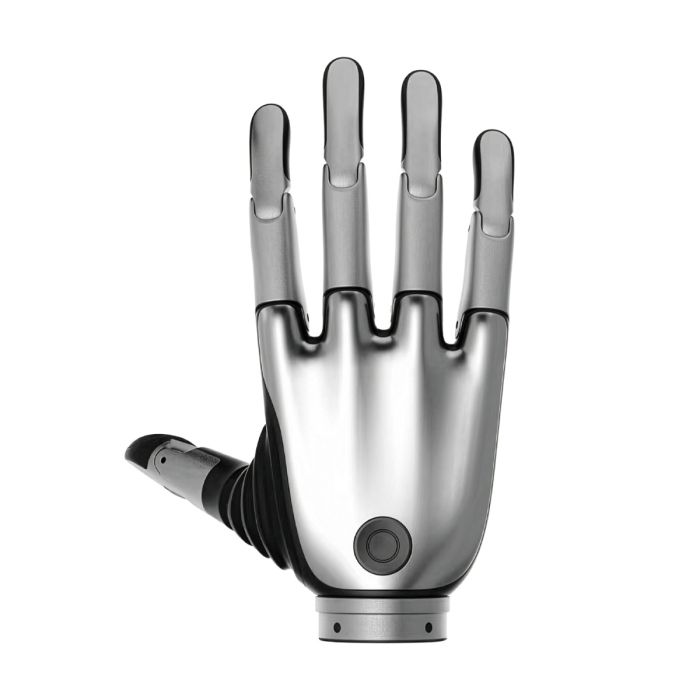
BrainCo Revo 2 Pro Dexterous Left Hand (XEL)
In stock
- BRAND:
- BRAINCO
- MODEL:
- REVO 2 PRO
- PART #:
- XEL
- ORIGIN:
- China
- AVAILABILITY:
- SUBJECT TO AVAILABILITY
- SKU:
- BrainCo-Revo-2-Pro-Left
BrainCo Revo 2 Pro Dexterous Left Hand (XEL)
A humanoid robot can carry two arms and still work with only one hand, if the other is an afterthought. Holding a part steady with one hand while the other acts on it is the everyday test of bimanual manipulation, and it asks the left hand to be as capable as the right. The BrainCo Revo 2 Pro Dexterous Left Hand (XEL) is built for that role: a bionic hand for robot integration and research, with closed-loop servo control, protective functions and industrial communication interfaces.
The BrainCo Revo 2 Pro Dexterous Left Hand (XEL) is available through this page, by quotation.
Background
BrainCo and the Revo 2 series
BrainCo is a company associated with bionic technology, and the Revo 2 is presented as a bionic dexterous hand for robot integration and research. The word bionic is the key to the design philosophy. The hand is meant to follow the proportions and movement of a human hand, rather than to behave as an industrial gripper with additional fingers. For anyone building a humanoid platform, that matters because the objects and tools such a robot is expected to handle were made for people.
The series is organised in three tiers, and each tier is offered as a left and a right unit. The Basic version carries the codes XRL and XRR, the Pro version XEL and XER, and the Touch version XTL and XTR. The product described here is the left-hand unit of the Pro tier, code XEL. Its mirrored counterpart is the XER, so a bimanual system can be fitted with a matching pair.
Positioning and key technology of the Pro tier
The Revo 2 hand provides 6 active joints and a total of 11 degrees of freedom. The difference between those two numbers is worth understanding. Not every degree of freedom is driven by its own motor; the hand has 6 actuated joints, and the full set of 11 describes the range of articulation that the finger mechanism achieves with them. In practice this lets the hand shape itself around an object with a natural finger posture without needing a motor for every joint.
Control is closed-loop servo control, with custom gesture definitions that allow an integrator to define and store the hand postures an application needs. Protection is built in for current, stall, high-temperature and collision conditions. For the communication layer, the Revo 2 supports RS485, CAN FD and EtherCAT interfaces, and software support is provided as an SDK for Linux, Windows and ROS workflows. Taken together, these features place the Pro tier as a hand for teams that need to connect a dexterous end effector to an existing control architecture rather than build one around it.
Technical Specifications
| Specification | Value |
|---|---|
| Product | BrainCo Revo 2 Pro Dexterous Left Hand |
| Version code | XEL (the right-hand counterpart is XER) |
| Active joints | 6 |
| Degrees of freedom | 11 in total |
| Pinch force | ≥15N |
| Control precision | 0.1° |
| Communication interfaces | RS485, CAN FD, EtherCAT |
| Protection functions | Current, stall, high-temperature and anti-collision protection |
| Control features | Closed-loop servo control, custom gesture definitions |
| SDK support | Linux, Windows and ROS workflows |
| Standard colours | Space Gray, Silver (bulk colour customisation is supported) |
Specifications as published by the manufacturer; confirmed against the datasheet at quotation.
The manufacturer has not published the weight of the Pro version, the IP rating, the contents of the box, the cable length or the certifications; they are confirmed at quotation.
What makes the Pro version suited to integration work?
A dexterous hand succeeds or fails on the strength of its interface to the rest of the machine. The Revo 2 offers three communication options: RS485, CAN FD and EtherCAT. These are the interfaces that appear most often in robot control cabinets, humanoid joint buses and laboratory automation cells. A team that has already standardised on one of them can usually avoid a protocol bridge, and a team that has not can choose the one that best suits its controller and its latency requirements.
The software side points the same way. SDK support for Linux, Windows and ROS workflows covers the three environments in which research groups and integrators most commonly work. A laboratory running ROS on Linux and a commissioning engineer working from a Windows laptop can both reach the hand with supported tools. This is a practical advantage on a project where several people with different habits touch the same hardware.
Control precision of 0.1° and pinch force of ≥15N describe the hand at the level of its motion and its grip. Precision tells the integrator how finely a finger posture can be commanded; pinch force tells them what the thumb and finger can hold between them. Neither figure alone settles whether the hand suits a given task, but together they give a sound starting point for judging grasp planning with small and medium household or laboratory objects.
How does the hand protect itself and the objects it holds?
Behaviour when a grasp goes wrong is a better measure of a hand than its best-case performance. A finger can meet an unexpected edge, a motor can stall against a jammed part, or a component can run warm during a long programme of trials. The Revo 2 addresses each of these with a named protection: current protection, stall protection, high-temperature protection and anti-collision protection.
These protections work alongside closed-loop servo control. Because the hand monitors its own state, it can respond to an overload rather than continue to drive into it. For a research team, that reduces the risk of damage to the hand during early experiments, when unexpected contact is most likely. For an integrator, it is one less safeguard to build into the surrounding software.
Custom gesture definitions complete the picture. An application that repeatedly needs the same few postures, such as an open palm, a pinch or a closed grip, can define them once and call them as needed. This keeps higher-level code simple and makes behaviour easier to repeat from one trial to the next.
Who is the BrainCo Revo 2 Pro Dexterous Left Hand (XEL) for?
The first segment is the humanoid robot developer, who needs a left hand that matches the right and fits human-scaled arms. For a matching pair, the right-hand unit is the BrainCo Revo 2 Pro Dexterous Right Hand (XER).
The second is the university or industrial research laboratory studying manipulation, teleoperation or learning from demonstration. Such teams value open software support and protective behaviour more than a fixed set of built-in tasks, and the Linux, Windows and ROS support suits them.
The third is the system integrator who must connect a hand to an existing EtherCAT, CAN FD or RS485 network. Buyers who are weighing other tiers of the series can look at the BrainCo Revo 2 Basic Left Dexterous Bionic Hand (XRL) or the Brainco Revo 2 Touch Biomimetic Dexterous Left Hand (XTL); the differences between tiers are confirmed at quotation. The wider range is listed under Hands and in the BrainCo Revo 2 category.
What is the BrainCo Revo 2 Pro Dexterous Left Hand (XEL) used for?
- Bimanual humanoid manipulation. The left hand holds or steadies an object while the right hand works on it.
- Robot hand research. Laboratories study grasping, in-hand motion and control strategies on a human-scaled mechanism.
- Teleoperation development. Operators drive the hand through custom gesture definitions and the supported SDK.
- Fieldbus integration projects. Integrators connect the hand to RS485, CAN FD or EtherCAT networks in an existing control architecture.
- Prototype handling tasks. Engineers test pinch and grasp routines on objects made for human hands.
- Teaching and demonstration. Courses and demonstration cells show a bionic hand with documented protections and software support.
Pricing and Availability
No price is listed on this page, because every supply of the hand is quoted individually. Quotation is the next step: the request sets out the quantity, the colour and the integration needs. Delivery, customs and support are arranged with the quotation. The BrainCo Revo 2 Pro Dexterous Left Hand (XEL) is available on this page.
Frequently Asked Questions
How many joints and degrees of freedom does the hand have?
The hand has 6 active joints and a total of 11 degrees of freedom.
Which communication interfaces does it support?
The Revo 2 supports RS485, CAN FD and EtherCAT communication interfaces.
Which software environments are supported?
SDK support is provided for Linux, Windows and ROS workflows.
What protections does the hand include?
It includes current protection, stall protection, high-temperature protection and anti-collision protection, together with closed-loop servo control.
What pinch force and control precision are published?
The published pinch force is ≥15N and the control precision is 0.1°.
Is there a right-hand version, and what colours are offered?
The right-hand counterpart of the Pro tier is the XER. Standard colours are Space Gray and Silver, and bulk colour customisation is supported.
Where can I buy the BrainCo Revo 2 Pro Dexterous Left Hand (XEL) and what does it cost?
It can be bought through this page by requesting a quotation. The cost is given in the quotation, which also covers delivery, customs and support.
Summary
A bimanual robot is only as capable as its weaker hand, and the left side is where that weakness is most often found. The BrainCo Revo 2 Pro Dexterous Left Hand (XEL) answers with 6 active joints and 11 degrees of freedom, a pinch force of ≥15N, control precision of 0.1° and four named protections. It connects through RS485, CAN FD or EtherCAT and is supported by an SDK for Linux, Windows and ROS. For a team that wants to equip the left arm with a hand of the same standard as the right, this page is the starting point.
Specifications
General
Physical
Mobility
Performance
Connectivity
Software
Hand
Feature
1. High quality and stability – five years of product iteration and professional production lines.
2. Lightweight (383 grams), with 5 kg active grip force, 20 kg single-hand load capacity, and a grip-to-weight ratio of 53.
3. Ergonomic Bionic Design – supports curved surface grasping with anti- collision finger design.
4. Multi-dimensional tactile perception – pressure, friction, direction, proximity, and surface texture.
5. High Sensitivity Tactile Perception – max resolution of 0.01N.
6. Wide voltage support – 64V.
7. Universal Interfaces – RS485 & CAN-FD, and EtherCAT.
8. Standard Protocols and SDKs – Modbus & Protobuf protocols, SDKs for Python / C / ROS.