BrainCo Revo 2 Pro Dexterous Right Hand (XER)
In stock
- BRAND:
- BRAINCO
- MODEL:
- REVO 2 PRO
- PART #:
- XER
- ORIGIN:
- China
- Warranty:
- 12 MONTHS
- AVAILABILITY:
- SUBJECT TO AVAILABILITY
- SKU:
- BrainCo-Revo-2-Pro
BrainCo Revo 2 Pro Dexterous Right Hand (XER)
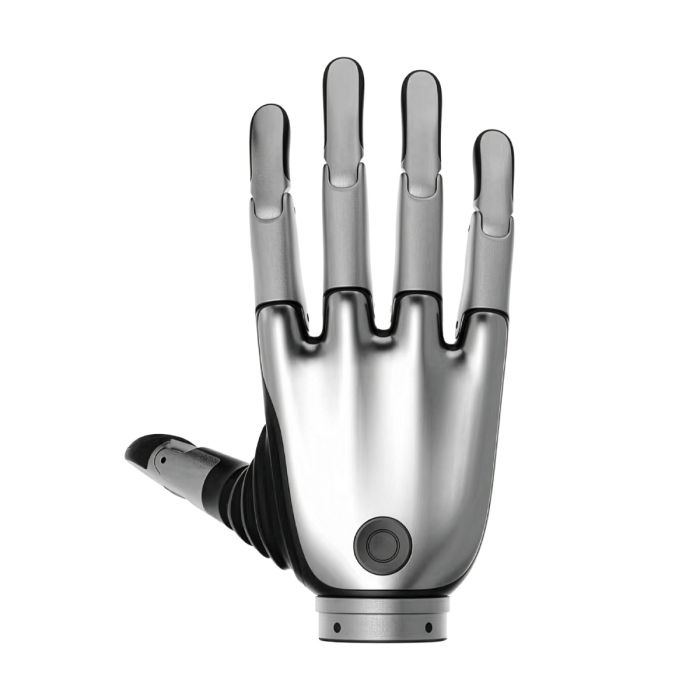
Most dexterous hands are judged on how they move; fewer are judged on how they are commanded. The BrainCo Revo 2 Pro Dexterous Right Hand (XER) invites the second kind of scrutiny. It is a bionic hand for robot integration and research, and its Pro designation rests on the way it connects to a robot: three communication interfaces, with the connector placed below the wrist, and SDK support for the operating systems that research teams already use.
The product is available through this page, by quotation.
Background
BrainCo and the Revo 2 range
BrainCo's Revo 2 hands are organised in three versions, each made as a left and a right hand: Basic (XRL/XRR), Pro (XEL/XER) and Touch (XTL/XTR). The whole range is gathered in the BrainCo Revo 2 category, which in turn belongs to the wider selection of Hands for humanoid and research robots. The Revo 2 is a bionic dexterous hand for robot integration and research. That places it as a component for engineers, laboratories and system integrators rather than as a finished robot or a consumer product.
Positioning of the Pro version
The XER is the right-handed hand of the Pro tier, whose version code is XEL for the left and XER for the right. The mechanical concept is shared across the series: six active joints and eleven degrees of freedom. The thumb has two active degrees of freedom for abduction and adduction, together with one passive degree of freedom for flexion and extension. Each of the four remaining fingers has one active and one passive degree of freedom for flexion and extension. The Pro version, like the tactile version, supports three communication interfaces, RS485, CAN FD and EtherCAT, for communication and control. The interface is located below the wrist, which is where a cable run from the forearm of a robot would naturally arrive.
Technical Specifications
| Specification | Value |
|---|---|
| Product type | Bionic dexterous hand for robot integration and research |
| Version and handedness | Pro, right hand (XER); the left hand is XEL |
| Active joints | 6 |
| Degrees of freedom | 11 |
| Thumb | Two active degrees of freedom (abduction and adduction); one passive degree of freedom (flexion and extension) |
| Each of the four fingers | One active and one passive degree of freedom for flexion and extension |
| Communication interfaces | RS485, CAN FD, EtherCAT |
| Interface location | Below the wrist |
| SDK support | Linux, Windows and ROS workflows |
| Control | Closed-loop servo control; custom gesture definitions |
| Protections | Current, stall, high temperature and collision conditions |
Specifications as published by the manufacturer; confirmed against the datasheet at quotation.
The manufacturer has not published the dimensions, the wrist mounting dimensions, the material, the IP rating or the service life; they are confirmed at quotation.
What makes the Pro version different from the Basic and Touch versions?
The three versions share the same joint architecture, so the choice between them is not about how many fingers move or how many joints are driven. It is about what surrounds the mechanism. The Pro version, together with the tactile version, supports RS485, CAN FD and EtherCAT. For an integrator, that matters because the hand can be matched to the bus the robot already uses instead of forcing the robot's controller to adapt to the hand.
The Touch version is the one to consider when tactile sensing is the point of the experiment, and the right-hand model is the Brainco Revo 2 Touch Biomimetic Dexterous Right Hand (XTR). The entry model for the same side is the BrainCo Revo 2 Basic Right Dexterous Bionic Hand (XRR). The Pro version sits between them for teams that need the communication options but have not made tactile feedback the centre of their work.
What does the control and protection design offer?
The hand uses closed-loop servo control, which allows finger positions to be commanded and held rather than merely triggered. Custom gesture definitions let a team store the hand poses its experiments rely on and recall them, instead of rebuilding them in every programme. The protections cover current, stall, high temperature and collision conditions. These are the situations in which a hand is most likely to be harmed during early trials, when a grasp is attempted on an unexpected object or a joint is driven against an obstruction.
On the software side, the SDK supports Linux, Windows and ROS workflows. A laboratory working in ROS can therefore bring the hand into its existing tooling, while a group that develops on Windows is not excluded.
Who is the BrainCo Revo 2 Pro Dexterous Right Hand (XER) for?
The first group is the university or corporate research laboratory studying manipulation, where the end-effector is a variable of the experiment and must be programmable at several levels. The second is the robot integrator who is fitting a hand to a humanoid or a manipulator arm and needs it to attach to a fieldbus the machine already runs. The third is the development team that works across more than one operating system and wants one hand to serve both.
The XER is the right hand. A bimanual platform needs its counterpart, the BrainCo Revo 2 Pro Dexterous Left Hand (XEL), so that both sides share the same version and the same interfaces. Teams that need tactile sensing should look at the Touch version instead, and teams with a tighter scope may find the Basic version sufficient.
What is the BrainCo Revo 2 Pro Dexterous Right Hand (XER) used for?
- Manipulation research. Studying how finger articulation and grasp strategy change with the object and the task.
- Humanoid robot integration. Providing the right-hand end-effector on a humanoid or dual-arm platform.
- Fieldbus-connected cells. Joining a robot system that communicates over RS485, CAN FD or EtherCAT.
- ROS-based development. Bringing a dexterous hand into a ROS workflow on Linux.
- Gesture programming. Defining and recalling custom hand poses for repeatable experiments.
- Protected trial work. Running early grasp trials with current, stall, temperature and collision protections in place.
Pricing and Availability
No price is shown on this page; the hand is supplied by quotation, which allows the version, handedness and integration needs to be settled together. Delivery, customs and support are arranged with the quotation. The BrainCo Revo 2 Pro Dexterous Right Hand (XER) is available on this page.
Frequently Asked Questions
How many joints and degrees of freedom does the hand have?
It has six active joints and eleven degrees of freedom. The thumb contributes two active and one passive degree of freedom, and each of the other four fingers has one active and one passive.
Which communication interfaces does the Pro version support?
It supports RS485, CAN FD and EtherCAT. The interface is located below the wrist.
Which software environments does the SDK cover?
The SDK covers Linux, Windows and ROS workflows.
What protections does the hand include?
It includes protections for current, stall, high temperature and collision conditions, together with closed-loop servo control.
Is there a left-hand version of the Pro hand?
Yes. The left hand in the Pro version carries the code XEL, while the right hand described here is the XER.
Are the dimensions, IP rating and material listed?
They are not listed in the table above, and neither are the wrist mounting dimensions or the service life. Ask for them when you request your quotation.
Where can I buy the BrainCo Revo 2 Pro Dexterous Right Hand (XER) and what does it cost?
The hand is available through this page by quotation, and no price is shown here. Send a request and the quotation will set out the terms for your project.
Summary
The case for the XER is not that it moves differently from its siblings, since the joint architecture is shared, but that it can be commanded in the way a robot system requires. Three communication interfaces, an SDK covering Linux, Windows and ROS, closed-loop servo control and a set of protections make it a considered choice for laboratories and integrators. For a hand that has to fit your robot's bus and software, this page is the starting point.
Specifications
General
Physical
Mobility
Performance
Connectivity
Software
Hand
Feature
1. High quality and stability – five years of product iteration and professional production lines.
2. Lightweight (383 grams), with 5 kg active grip force, 20 kg single-hand load capacity, and a grip-to-weight ratio of 53.
3. Ergonomic Bionic Design – supports curved surface grasping with anti- collision finger design.
4. Multi-dimensional tactile perception – pressure, friction, direction, proximity, and surface texture.
5. High Sensitivity Tactile Perception – max resolution of 0.01N.
6. Wide voltage support – 64V.
7. Universal Interfaces – RS485 & CAN-FD, and EtherCAT.
8. Standard Protocols and SDKs – Modbus & Protobuf protocols, SDKs for Python / C / ROS.