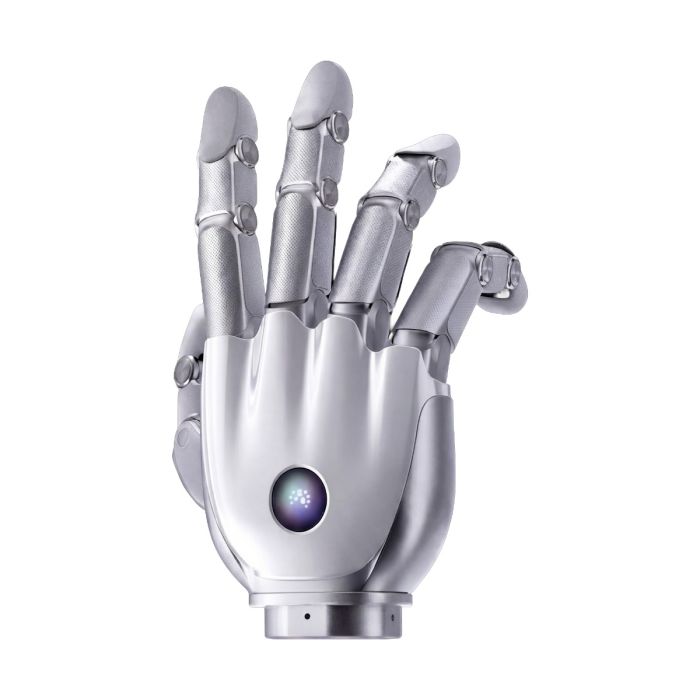
BrainCo Revo 3-21 Basic Robot Hand
In stock
- BRAND:
- BRAINCO
- MODEL:
- REVO 3-21 BASIC
- ORIGIN:
- China
- Warranty:
- 12 MONTHS
- AVAILABILITY:
- SUBJECT TO AVAILABILITY
- SKU:
- BrainCo-Revo-3
BrainCo Revo 3-21 Basic Robot Hand
A thumb with five degrees of freedom is a design decision, not an ornament. It says that the hand is meant to oppose, pinch and reposition, and not merely to close around an object. The BrainCo Revo 3-21 Basic Robot Hand carries that decision through the whole palm: every finger has its own driven joints, and the thumb has the most of all. For teams that have reached the limit of what a two-jaw gripper can express, the interest lies in what a controller is permitted to ask of each finger.
The BrainCo Revo 3-21 Basic Robot Hand is available through this page, by quotation.
Background
BrainCo and the Revo family
BrainCo was founded in 2015 and now offers three robotic products. The Revo name has run through several generations of dexterous hand. Earlier models include the BrainCo Revo 1 Intelligent Dexterous Bionic Hand and the Revo 2 hands, such as the BrainCo Revo 2 Basic Right Dexterous Bionic Hand (XRR). The Revo 3 is the line this hand belongs to, and the sources name several versions within it: Revo 3 U21, U21F, U21T and U21VT, together with the Basic, Touch and Vision variants. The full range can be browsed in the BrainCo Revo 3 category.
Positioning and key technology
The Revo 3 is a biomimetic dexterous hand designed for industrial automation, scientific research and advanced robotics manipulation. Its architecture rests on 21 independently driven motors, giving 21 fully active degrees of freedom: five in the thumb and four in each of the index, middle, ring and little fingers. Nothing in the hand is passively coupled to a neighbouring joint, so a controller can address each degree of freedom on its own.
The joints are direct-driven and backdrivable. In practice this means the mechanism can be moved from the outside and can follow an external push, while still responding rapidly and offering a high density of control across all finger segments. The hand is rated for over 1,000,000 joint flex cycles. Development is supported by cross-platform C/C++ and Python SDKs for Linux and Windows, which allow the hand to be brought into an existing software workflow without a separate toolchain.
Technical Specifications
The manufacturer's table is published for the Revo 3 U21 and is the same for all four U21 models. A reseller listing gives separate figures for the Revo 3 Basic. Both are shown, each in its own column.
| Specification | Revo 3 U21 (manufacturer table) | Revo 3 Basic (reseller listing) |
|---|---|---|
| Degrees of freedom | 21 active, independently driven | 21 active, independently driven |
| Hand dimensions | 216 × 108 × 50 mm | 215 × 105 × 50 mm |
| Supply voltage | 16–85 V | 12–80 V |
| Max current | 10 A (24 V) | — |
| Active grip force | ≥100 N | >70 N |
| Max fingertip pinch force | ≥25 N | — |
| Total hand payload | 20 kg | — |
| Four-finger payload | 5 kg | — |
| Repeatability | 0.1° | — |
| Joint open/close time | 0.33 s | — |
| Max grasping diameter | 150 mm | — |
| Communication interfaces | EtherCAT / CAN FD / RS-485 | — |
| Communication frequency | 500 Hz | — |
| Onboard sensors | IMU (mainboard), temperature (mainboard) | — |
| Tactile sensors | — | Not included |
| Control modes | — | Position / MIT Force-Position / Admittance / Zero-Torque |
| Joint flex cycles | Over 1,000,000 | Over 1,000,000 |
Specifications as published by the manufacturer; confirmed against the datasheet at quotation.
The manufacturer has not published the weight, the box contents, the IP rating, the operating temperature range or the power consumption; they are confirmed at quotation.
What makes the Revo 3 Basic different from the Touch and V-Touch versions?
The most direct difference is sensing. The Revo 3 Basic does not include tactile sensors, and its onboard sensing is limited to the mainboard, which carries an IMU and a temperature sensor. The hand therefore reports its own joint state and body condition, but not contact over the fingertips or palm. A team that controls grasping from joint position, force-position behaviour or admittance will find that sufficient. A team that needs the hand to feel an object before deciding what to do next should look at the BrainCo Revo 3-21 Touch Robot Hand or the BrainCo Revo 3-21 V-Touch Robot Hand.
The motors, the joints and the mechanical architecture are not what separates the versions. The 21 degrees of freedom, the direct-driven backdrivable joints and the SDKs are common to the Revo 3 family as the sources describe it. Choosing the Basic version is therefore a decision about how much of the sensing the project needs, not about how dexterous the hand is.
Why do direct-driven, backdrivable joints matter?
A joint that cannot be backdriven resists any force applied from outside. That is acceptable for a pick-and-place gripper in a guarded cell, but awkward for a hand that must touch things, be guided by a person, or yield when it meets an obstacle. Because the Revo 3 joints are direct-driven and backdrivable, an external push on a finger can be followed by the mechanism. This is especially useful in the Zero-Torque and Admittance control modes listed for the Basic version, where the hand is meant to give way and not to hold position at any cost.
The same property supports teaching and demonstration work. An operator can move the fingers by hand, observe the joint response, and compare it with commanded behaviour. Combined with a communication frequency of 500 Hz and EtherCAT, CAN FD and RS-485 interfaces, the hand can be placed on the type of bus an integrator already uses.
Who is the BrainCo Revo 3-21 Basic Robot Hand for?
The first group is university and corporate laboratories working on manipulation, grasp planning and learning-based control. They benefit from a hand in which each of the 21 degrees of freedom can be commanded separately, and from C/C++ and Python SDKs that run on both Linux and Windows. The second group is industrial integrators who need a multi-fingered end effector for tasks that a parallel gripper cannot perform, such as handling irregular parts or using a tool.
The third group is developers of humanoid and general-purpose robot platforms who need a hand with a defined mechanical envelope and a standard industrial communication interface. For any of these buyers, the Basic version is the sensible choice when the controller can work without tactile feedback. Buyers who require contact sensing should instead consider the Touch or V-Touch versions.
What is the BrainCo Revo 3-21 Basic Robot Hand used for?
- Dexterous manipulation research. Each finger joint can be commanded individually, so experiments in in-hand movement and grasp strategy are not limited by the hardware.
- Industrial automation. A multi-fingered end effector can handle parts whose shape or size varies, where a two-jaw gripper would need changing.
- Humanoid and mobile robot platforms. The hand provides a human-scale mechanism at the end of an arm, with standard industrial communication interfaces.
- Compliant and guided interaction. Backdrivable joints and the Admittance and Zero-Torque modes let the hand yield to contact or be guided by an operator.
- Teleoperation and demonstration. An operator's hand motion can be mapped onto the independently driven joints to record or reproduce a skill.
- Software and control development. The C/C++ and Python SDKs for Linux and Windows allow controllers and learning pipelines to be written and tested against real hardware.
Pricing and Availability
This page does not list a price. The call to action is a quotation request, which sets out the configuration and the terms for your project. Delivery, customs and support are arranged with the quotation. The BrainCo Revo 3-21 Basic Robot Hand is available on this page.
Frequently Asked Questions
How many degrees of freedom does the hand have?
It has 21 fully active, independently driven degrees of freedom. The thumb has five, and the index, middle, ring and little fingers have four each.
Which communication interfaces does it offer?
The manufacturer's table lists EtherCAT, CAN FD and RS-485, with a communication frequency of 500 Hz.
Does the Basic version include tactile sensors?
No. The Revo 3 Basic does not include tactile sensors. Onboard sensing in the manufacturer's table is an IMU and a temperature sensor on the mainboard.
Which control modes are available?
The Revo 3 Basic lists Position, MIT Force-Position, Admittance and Zero-Torque modes.
What software support is provided?
Cross-platform C/C++ and Python SDKs are provided, compatible with Linux and Windows.
How long is the hand rated to last?
It is rated for over 1,000,000 joint flex cycles.
Where can I buy the BrainCo Revo 3-21 Basic Robot Hand and what does it cost?
It is available through this page by quotation. No price is published here; send a quotation request and the terms are set out for your project.
Summary
The five-joint thumb that opened this article is the clearest sign of what the hand is for. The BrainCo Revo 3-21 Basic Robot Hand gives a controller 21 independent degrees of freedom, backdrivable direct-driven joints, industrial communication interfaces and SDKs for Linux and Windows. It leaves out tactile sensing, which the Touch and V-Touch versions address. For laboratories, integrators and platform developers who want fine finger control, this page is the starting point.